Thursday, December 15, 2022

Toy Story

The Micronauts was an American repackaging of a line of Japanese toys and action figures. It was never a construction system like Lego, but the figures had joints and connections of a consistent size, so any robot or spaceship could be disassembled and put back together in a different configuration. Spaceships could become cities and cities could become robots. "The Interchangable World of the Micronauts", they called it.

They were pretty generic space-toys, actually. "Microtron" looked a lot like a dozen other clockwork or battery powered robots. "Biotron" was another undistinguished automaton, albeit with an incongruous silver humanoid face. The spaceships were equally un-noteworthy, all pointy cockpits and delta-wings. 

But still, there was a certain ambience. The default action-figure -- the Micronaut -- is a gold headed robotic humanoid with a transparent plastic body. I think his head, with a retro-future rock n' roll quiff, was the same head as Biotron's. 

He was called Time Traveller. I don't know if he travelled in time. He looked a lot like my beloved Cyborg, the transparent robot Jesus who saved the Earth from a plastic purple Satan called Muton. Cyborg wasn't actually a cyborg, but he had an enemy named Android who was definitely an android. 

There turns out to have been a family resemblance. There had been a series of Japanese action figures called Henshin Cyborg; they were transparent and had robot innards and came in different colours. The UK market re-named them Cyborg and Muton and gave them a needlessly messianic backstory. But there was also a smaller, more accessorisable version of Henshin Cyborg called Micronman. Microman became Time Traveller for the US and UK markets. 

Interestingly enough, Henshin Cyborg had originally been based on GI Joe and GI Joe had been based on the British Action Man. So Micronauts was begotten of Microman, which was begotten of Cyborg, which was begotten of GI Joe, which was begotten of Action Man, the Hero With a Thousand costumes. 


Sandman has a library of books that were never written. Perhaps somewhere he also has a dusty trunk of toys that you never owned. I certainly never owned a Micronaut. I don't think I ever even handled one. But I saw the adverts on children's TV and on the back page of Star Wars weekly. I saw a big display underneath Santa's Grotto in Selfridges. I remember how they tasted. The robotic Time Travellers operating Science machines and piloting Science vehicles. There was a bad-guy in black armour who had a black horse and a good guy with white armour who had a white horse. Horse and rider sold separately. Being interchangeable, both of them could be configured as centaurs. I have always been a sucker for stories in which the villain is an exact mirror image of the hero.

I remember one particular morning on the way to school a space-centaur jumped into my head; half-man half-horse; with stormtrooper armour, leaping into the air firing laser beams from his eyes. I don't know if he had a flaming sword. I expect he had a flaming sword. The image had no context. I don't know if it was before or after I had seen the Micronauts figurines. I don't know if it was before or after Star Wars. But it made me jump for joy. If C.S Lewis is right joy is precisely what it made me jump for. 

"You're pretty young. A fellow will remember a lot of things you wouldn't think he would remember."


I don't know if I really need to say this, but I will. 

In 1978, homosexuality was still not fully legal in England. The BBC still showed black-face minstrel shows. Teachers were positively encouraged to hit pupils. Nuclear war seemed not only possible, but probable. We were just moving into the Winter of Discontent. We had the Falkands War, the Miners Strike, AIDS, Section 28 and Ronald Reagan still to look forward to. To think about the popular culture of a particular era does not imply that you think that that the era was necessarily a great time to be alive. If comic books and RPGs were truly better in the olden days it does not follow that everything else was better too. To look with fondness on your own childhood and adolescence is not necessarily to look with fondness on the past in general. The Golden Age of comics was not itself a golden age. It may, in fact, be that they invented rock and roll in the 1950s because the 1950s were so awful; and that they invented punk in the 1970s because the 1970s were so awful. It may be that romantic poetry is the opposite of the industrial revolution. It may be that I ran away to the microverse because I was just basically unhappy. 

I don't know if I really needed to say any of that, but I have. 


A toy is not an object but an idea. A cheap ray gun selling for 50p in a market stall is not a lump of plastic designed for some knock-off company by a lazy designer who hasn't heard of Prince Wayfarer or Adam Warlock and wouldn't care about them if he had. It isn't even a marvellous toy that goes zip when it moves and whir when it stops, at least until the friction drive wears out. It is an artefact from an implicit science fiction universe. It is you transformed into a space cadet or a cowboy in an alien bar. You don't need to own it. You are probably too old to play, in that sense, with toys (and too young to be a collector). But the spell lasts for the whole bus-ride home.

"But if you want to play at being a space cadet, you can as well play at being a space cadet with a ray gun made from a toilet roll tube and some silver foil as with a cheap lump of Hong Kong garbage which will break inside a week."  Parents don't get this stuff. 


Don't sell the sausage, sell the sizzle, salesmen are told. When uber-hack Bill Mantlo turned the Micronauts into a Marvel Comic, what he emphatically sold was the sizzle.


Bill Mantlo gets a footnote in comic book history because he created Rocket Racoon. Rocket Racoon has become something of a cult since Guardians of the Galaxy became a movie. He was a guest star in an episode of the incredible Hulk. He helped the Hulk retrieve Gideon's Bible from a bad guy. The story was called Somewhere Near the Black Holes of Sirius There Lived a Young Boy Named Rocket Racoon. Bill Mantlo really liked the White Album. 

Hulk #271 was not, in fact, the first appearance of Rocket Racoon. We will come back to this point eventually, and you will be mildly surprised. 

Bill Mantlo has a bit of a bum rap as a Marvel Comics "company man". And it's true that any run of any Marvel comics series from the late 70s or early 80s will periodically be interrupted by a low-quality out-of-sequence episode written by Mantlo. It's quite disconcerting to be reading through Don McGregor's art-house Kilraven, or Doug Moench's proto-cyberpunk Deathlock and suddenly find the main story paused in favour of by a by-numbers Mantlo episode, often with an inappropriate guest star. 

There's a reason for this. One of Mantlo's first gigs was to write a notional Marvel Fill In Comic, one issue a month, so the company could stockpile a backlog of material which could then be printed when a writer or an artist missed their deadline. That happened quite often in the bad old days. Prior to Mantlo, when an artist got called up for jury service or a writer got food poisoning Marvel would reprint a previous issue and pretend it was a flashback. It was the comic book equivalent of a clip show. 

Mantlo didn't always respect his predecessor's work. He took over Alpha Flight (the Canadian Avengers) from John Byrne and took exactly one issue to excise every single idea which had made Byrne's comic feel like a breath of slightly fresher than usual air. When Steve Gerber lost control of his highly personal Howard the Duck, it was Bill Mantlo who stepped forward to write an instantly forgettable conclusion. Some people have never quite forgiven him for that.

And yet. 

When fans of a certain age start to wax nostalgic about the seventies and the eighties it is quite likely to be a Mantlo title -- Rom: Spaceknight, Jack of Hearts, Cloak and Dagger -- that they'll be talking about. There's a very thin line between the derivative and the archetypal. Rom, the alien in power armour who falls from the sky to fight shape shifting aliens who have secretly conquered the earth without anyone noticing feels like a "these you have loved" tribute to every old-fashioned superhero comic and every science fiction B-movie. And it ends with a multi-hero crossover before such things were fashionable. 

Dammit, I remember the fill-in issue in which Tony Stark recalls that day in the 'Nam when he renounced the arms trade; and the fill-in issue in which Peter Parker places a very old microscope on the grave of Uncle Ben better than I remember some of the deathless classics of the era. The reason is not hard to see: Mantlo had taken every issue of Iron Man and every issue of Spider-Man, chewed them up, and spat them back at us. Perhaps because he was not himself a fan (he really wanted to be a lawyer) he could see the characters with fresh eyes. The fan favourites of the era, Panther's Rage and Master of Kung Fu and what-not can seem a little worthy and pretentious by comparison. 

So. The Micronauts. Call it pastiche, homage, blatant rip-off. It was all of those things. But sometimes it feels more like Star Wars than Star Wars itself. 

*

In 1992 Bill Mantlo was involved in a catastrophic road accident, suffering brain damage from which he has never recovered. It is said that he has seen Guardian of the Galaxy, and was able to recognise Rocket Racoon.


Hi,

I'm Andrew.

I am trying very hard to be a semi-professional writer and have taken the leap of faith of down-sizing my day job.


If you have enjoyed this essay, please consider backing me on Patreon (pledging £1 each time I publish an article.) 


 Pledge £1 for each essay.


Saturday, December 03, 2022

1978


That first poster was strangely static. A bare-chested male hero, holding some kind of shining light or torch above his head; a woman, with one leg provocatively unclothed, below him. She has a ray gun, but it is hanging flaccidly at her side; the hero is holding his weapon or wand or magic lamp aloft, dividing the frame into quarters. 

They aren't identifiable as the film characters: either Mark Hamill and Carrie Fisher hadn't been cast when it was painted, or else the artist (one Tom Jung) didn't have reference material to hand. 

They are standing on a sandbank. It could be Tatooine, but Leia doesn't go to Tatooine in the film. And apart from a brief training sequence on the Falcon, Luke never actually wields his lightsaber. (And anyway a lightsaber is a short coloured beam, not a silvery beacon that reaches up to the sky.) The droids and the cloud of X-Wing fighters -- far more than appear in the film -- are small and indistinct.  

Behind everything an imposing, ethereal face. It could be a man in a helmet; it could be a robot. His blackness merges with the blackness of the stars. There is no clue as to who he is; but he dominates the frame: at some level, he is what this movie is about.

The poster is selling us a film which is alien and Other; wistful and slightly exotic. It's a science fiction film -- there are robots and spaceships and ray guns and some kind of space station -- but they are part of the background; not the selling point. We are focussed on a hero and a heroine who look as if they came off a Frank Frazetta sword-and-sorcery paperback cover. 

A long time ago in a galaxy far, far away. We are intrigued, rather than thrilled. If the poster had a soundtrack, it would be Leia's theme or the Stravinsky-inspired Tusken music. 


If the second poster had had a sound track, it would have been the Twentieth Century Fox fanfare, or perhaps  the Imperial March Track 15, the Last Battle. It is safe and familiar, a group of comrades on an adventure. Where the first was static, this one is full of action. There is a cast of thousands, including recognisable stars like Alec Guiness and Peter Cushing. The hero and the heroine are identifiable as Hamill and Fisher, and they are fully clothed. 

Luke, at the front, points his blaster directly at us; Leia, behind him, is in an active combat pose. Han is behind her, firing a blaster in the other direction. The first poster was neatly split in three by Luke's mysterious flaming sword; this one is split by blaster bolts, zapping out of the frame at jaunty angles. The X-Wings have go faster rockets blasting out of their rears; they are chased by overwhelming numbers of TIE fighters. The other poster was located on Tatooine; this shows the characters suspended in space, against a starry backdrop. 

Darth Vader again dominates the picture; but he's no longer a disembodied face. He stands behind the main group, towering above them. He is holding a sword like weapon. The beam is much like the beams from the hero's ray-guns. We may not yet know that the tool hanging between Luke's legs is called a lightsaber but we can hardly fail to spot its phallic significance. But it's that intriguing laser sword which dominates the picture. The bad guy is a knight from an older world: the hero is a contemporary space cowboy. 


Most of us knew Star Wars as a comic before we had seen the film. Howard Chaykin's cover has the same vibe as the second poster. A dynamic group of heroic figures, facing the reader. An abstract image which doesn't represent anything which happens in the story -- Leia and Ben are never in the same room -- but which incapsulates the movie.

Luke is still facing the reader, but he now has a lightsaber, not a gun. Ben is now behind him, and it's his lightsaber beam which shoots out of the right of the fame. Han is still on Luke's left, firing his blaster. Leia is behind them, weirdly aloof. Two X-Wings are flying towards us; they could even be threatening the group. 

Where the two film posters showed a very small Death Star in the top left hand corner, the comic book makes it dominate the picture, framing the group. Either we see it in the moment of its destruction, or else it is supposed to be eclipsing the sun. (The darkness blocking out the light: the movies didn't get to that symbolism until the Force Awakens.) 

And behind the four heroes, again, is an enlarged face of Darth Vader shaded, bizarrely, in green. Green is an easier colour to deal with in cheap four colour printing that black and white. Just ask the Hulk. 


Now: fast forward to September 1978. 

Star Wars is a very long time in the past; the Empire Strikes Back is a very long time in the future. Time passed slowly in the 1970s. Battlestar Galactica has just started on TV, if you are that desperate. 

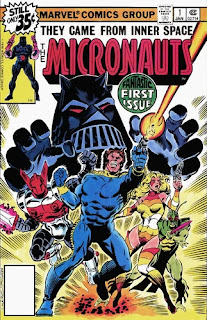
Run your eyes along the "spinner" at your "drug store", or the import section in the basement of Dark They Were And Golden Eyed. Marvel has launched a new comic book. (They've been trailing it for several months.) Have a look at the cover. And experience a brief, agreeable moment of deja-vu?

An heroic, musclebound figure in a blue jump suit. A generic Marvel tough guy. Paint a skull on his chest and he could pass for the Punisher. But he's firing a ray gun out of the panel: like Luke Skywalker. Stan Lee doesn't wholly approve of ray-guns, but since Star Wars arguably saved the company from bankruptcy, his attitude has softened.

Behind him, fanned out at roughly 45 degrees; are three other characters. A girl, in a colourful, sprayed on bikini, also with a ray gun. An alien, wielding something which could be a spear. And a medieval knight, red and white armour, with a sword. It's a metal sword, not a lightsaber, but it glows with some kind of energy. The girl hides behind the hero; the alien hides behind the girl. The knight stands behind the hero, but he's clearly advancing. 

The group are surrounded by motion lines: there is a small outbreak of Kirby Krackle at their feet. 

And behind them all, in a black helmet, horned like the Devil, a figure in black. His mouth, covered by something which could be a grate or a portcullis; as if his face were a piece of gothic architecture. His hands, held up, detached from his body as if grabbing the heroes. A venerable comic book motif, this. Kriby used it on the cover of Fantastic Four #49. Chris AchillĂ©os did a homage on the cover of the novelisation of The Three Doctors. We don't know who he is, but he's clearly not a goodie.  


A hero. 

A space-knight. 

A princess. 

An alien. 

Blaster swords. 

Laser fire. 

And behind it all, a dark lord. 

It was very, very clear what was on offer.


I have been saying for some time that I would talk about Bill Mantlo and the Micronauts. 

So this is Andrew Rilstone, talking about Bill Mantlo and the Micronauts.

The Micronauts: best and most blatant and shameless of all Star Wars rip-offs. 

The Micronauts: the best bad comic book I have ever read. 


continues


I've been planning to write about Micronauts for several years, and I hope I have said most of what I wanted to say. 

As ever: I am trying to make part of my living writing niche stuff which interests me, and if you think it is worth reading, it would be incredibly cool if you either subscribed to my Patreon (pledging $1 per short article) or bought me a metaphorical cup of coffee on Ko-Fi.

With the effective demise of Twitter, it's increasingly difficult for micro-journalists to promote their work, so if you have found this, or any of my other material, in anyway interesting, please do mention it to your online communities. 


Thursday, November 10, 2022

Episode VI + VII

The Strange Death of Alex Raymond is, in complicated ways, unfinished. Sim sustained an apparently unexplained wrist injury which means he can no longer draw. The final pages of the comic are blue-tinted, to indicate that a second contributor, Carson Grubaugh, has taken over from Sim. (He isn't a believer in Sim's theories, but thinks there is something to them. Skeptical but spooked, he says.) Grubaugh is working from Sim's layouts -- big double page spreads (very reminiscent of parts of J.H Williams 's work on  Promethea) -- mapping the swirling influences of the metaphysical wassissname across history. It turns out that George Herriman launched five unsuccessful comic strips before Krazy Kat (which some people consider to be the greatest comic of all time). These five strips came out around the time of Alex Raymond's birth. This is

"either a comic arts metaphysics pentagram intended to encompass the new born Alex Raymond or a nearly unimaginably intricate five fold metaphysical foreshadowing coincidence"

A message from Sim to his Patreon supporters, explaining why The Strange Death of Alex Raymond will never be published, is part of the text: correspondence between him and publisher Sean Michael Robinson, encouraging him to carry on with it, are part of the afterword. The final correspondence talks in terms of a second volume that Dave is still working on. So although we get a fair idea of what Sim is driving at, we are a long way from having heard the whole theory. If everything connects to everything else, the whole theory is probably unachievable, in any case. If we get another 300 pages of this kind of material in five years time, I shall certainly read it, but I don't know if I will be particularly sad if it never happens. (I'd rather get more Beanworld.) 

It's all nonsense; in the same way that Objectivism is nonsense and the theory that the world ended in CE 70 and we are living in a divine hologrqm is nonsense. In the same way that talking to a sock-puppet snake or eating the body and blood of a dead Jewish hippy is nonsense. Sim thinks that the connections are so overwhelming as to rule out coincidence. I suppose that we could refute him by using the "look elsewhere" argument: are car crashes and the name Margaret more common 1949 comic books than at any other time? Is Margaret more common as a woman's name in those issues than anywhere else? Could we take a sample of comic books from some other date and find proof of some other metaphysical event: say, that Noddy is dead or that Paul McCartney is the son of God? 

But that's probably orthogonal to what Sim is doing. Proving that coincidences aren't statistically significant doesn't prove, to the true believer, that Things are not all fundamentally interconnected. Richard Dawkins says that things which people pray for don't happen with any more statistical frequency than things which people don't; that Queen Elizabeth II, who everyone in England had to pray for by law, didn't live any longer than lots of old ladies for whom no one was petitioning the almighty. I think a lot of fair minded people read that and say "You may be right; but I think you may have missed the point of prayer."

I read Watchmen and Promethea and From Hell and I feel that the Universe is a huge and complex web of symbols; even, if I don't in fact believe it. I am inside Alan Moore's head, and its an interesting place to visit even though I wouldn't want to live there. One of the reasons that C.S Lewis is so loved and so hated is that anyone reading about the death of Aslan feels (experiences, lives) the Christian doctrine of the Atonement. All I feel reading the Strange Death of Alex Raymond is that I am being bludgeoned over the head by an overwhelming quantity of facts. 

VII

Stephen Medcalf was one of the English tutors when I was at Sussex University. He had been a pupil of Hugo (fuck-not-an-elf) Dyson: I wish I had known that at the time. (Why, says Sim elsewhere, do we get so quick old and so slow smart?) One cold February he found a baby girl abandoned in a telephone box. If he had not been passing, the baby would certainly have died; I think he became her godfather. He later described how incredibly unlikely it was that he should have gone for a walk on that particular day, and taken that particular route, and even noticed that there was something in the phone booth. 

"I do, as it happens" he said "Think the event was providential. I do not mean that if I did not already believe in providence this event would have made me do so, but that, since I have that belief, the event fits readily to it."


Flash, I love you: but we only have eighteen hours to save the earth. 


Hi,

I'm Andrew.

I am trying very hard to be a semi-professional writer and have taken the leap of faith of down-sizing my day job.

If you have enjoyed this essay, please consider backing me on Patreon (pledging £1 each time I publish an article.) 

 Pledge £1 for each essay.

My extended Essay on Cerebus the Aardvark is available from Lulu press.